When we love, we reveal Jesus and his Father to others.

Philip said to him, “Master, show us the Father, and that will be enough for us.” Jesus said to him, “Have I been with you for so long a time and you still do not know me, Philip” (Jn 14:8-9)?

Again we see the Apostles struggling to understand that Jesus and the Father are one, that Jesus is the Son of God. Jesus attempts to explain again to Philip that whoever sees him sees the Father.

The challenge here is that Philip and Jesus are using the same language but talking from different points of view. When Philip is asking Jesus to show him the Father through physical eyes, he is asking to see God along the lines of what we might perceive from Michaelangelo’s Sistine Chapel painting of God. Jesus has been revealing the Father through the spiritual eyes of his works. Or: “He might be looking for a grand theophany, because his request of Jesus, Show us the Father, recalls Moses’ request of the Lord at Mount Sinai: ‘Let me see your glory!” (Exodus 33:18).” (Martin and Wright, 246).

God is not finite, he is not a being like we are. He is neither male nor female. We use the term Father because Jesus used it often to speak of him, and thus why we use the pronoun him. Jesus used analogous language to create a bridge of understanding for us who are finite, human beings to help us understand better that we can have a relationship with our God who is Infinite Act. God’s essence and his existence is one and the same. Even though God is beyond any genus of being, beyond any way for us to classify him, we can still know and experience God.

Jesus shared with Philip that “The Father who dwells in me is doing his works. Believe me that I am in the Father and the Father is in me, or else, believe because of the works themselves” (Jn 14:11).

When Jesus heals, exorcises demons, speaks on his own authority, associates with those on the peripheries, these are some of the ways he is revealing the Father. In these very acts, he is loving those in his midst, he is willing their good. When Philip and the Apostles believed in Jesus and acted in his name they revealed Jesus and so his Father to others. When we love one another as Jesus loves us, live and act from the love we have received from Jesus, we also will reveal Jesus and the Father to others!


Photo: Jesus helps us to remember that we are each beloved daughters and sons of his Father, to be loved by him, to breathe, receive, rest and abide in his love for us and to love in return.

Martin, Francis and William M. Wright IV. The Gospel of John. Grand Rapids, MI: Baker Academic, 2015.

Link for the Mass readings for Sunday, May 3, 2026


Jesus Christ, God from God, light from light, true God from true God.

Philip said to him, “Master, show us the Father, and that will be enough for us.” Jesus said to him, “Have I been with you for so long a time and you still do not know me, Philip? Whoever has seen me has seen the Father” (John 14:8-9).
Philip was one of the first of the apostles called by Jesus in Galilee (see John 1:43), and so had been with Jesus from the very beginning of his public ministry. He lived, learned, and traveled with Jesus. He experienced the power of his teaching with authority, the exorcisms, healings, and ways that Jesus interacted with him, the apostles, and others. Yet, he still had much to learn, as do we all about the core reality of who Jesus is.
Jesus, fully human, is also at the same time, fully divine. The struggle to understand this truth is on full display throughout the gospels. Those who believe in Jesus and have followed him, like Andrew and Philip, as well as the other disciples, are seeking to understand, but as we see with Philip in today’s account, they still fall short of the depth of the truth regarding who Jesus really is. Which is understandable, because to understand that Jesus is who he says he is, “I and the Father are one” (See John 10:30), is beyond our rational comprehension.
This is why so many within the leadership of the scribes, Pharisees, Sadducees, and the Sanhedrin (The Jewish High Council) are so vehement about crushing the rise of Jesus and his popularity. They understand Jesus very clearly, that by his very words and actions, he is declaring himself to be God. To them, that a human being could be God is blasphemous. So they seek to obliterate this heresy.
Along with the apostles, there were others who saw Jesus differently. They expressed faith and trust in Jesus. Their hearts and minds were open that there was something more to Jesus. They did not feel threatened, but something in the depths of their souls was moved to follow and stay close. Peter and Martha remained close and in time experienced deeper, spiritual insights. Peter, when Jesus asked the apostles, “Who do you say that I am?” replied, “You are the Christ, the Son of the living God” (see Mt. 16:15). During the exchange between Martha and Jesus regarding her brother Lazarus’ death, when Jesus asked her if she believed that he was “the resurrection and the life; whoever believes in me, even if he dies, will live… Do you believe this?” Martha said, “Yes, Lord. I have come to believe that you are the Messiah, the Son of God” (see John 11:17-27).
Even with these insights, Peter and Martha, still did not comprehend the fullness of who Jesus taught and revealed himself to be. As the apostles and other disciples would trust and grow in their understanding of Jesus so would the Church in the succeeding generations seek to understand and develop the truth of who Jesus is as well. From the Councils of Nicaea (325) and Constantinople (381) we received this line about the identity of Jesus in the Creed that each one of us affirms each Sunday: “I believe in one Lord Jesus Christ, the only Begotten Son of God, born of the Father before all ages. God from God, Light from Light, true God form true God, begotten, not made, consubstantial with the Father”.
This statement clearly affirms Jesus’ teaching that he and the Father are one. One God, while at the same time distinct in person and operation as Father and Son. Who Jesus is in relation to his human nature also was further understood as the hypostatic union. This is the dogmatic teaching that Jesus is one divine person, subsisting in two natures, fully human and fully divine. The incarnation is that historical event in which through the full ascent of Mary’s, “Yes,” the Son of God through the overshadowing of the Holy Spirit, entered the womb of Mary and took on flesh. The Son of God became human.
The Council of Chalcedon (451) helped to clarify this point of the two natures of Jesus subsisting in one divine person. Jesus has “two natures without confusion, without change, without division, without separation – the difference of the natures being by no means taken away because of the union, but rather the distinctive character of each nature being preserved, and [each] combining in one person and hyspostasis – not divided or separated into two persons, but one and the same Son and only begotten God, Logos, Lord Jesus Christ; as the prophets of old and the Lord Jesus Christ himself taught us about him, and the symbol of the fathers has handed down to us” (Pelikan, 264).
Jesus’ characteristics and natures of the divine and human are distinct. There is no co-mingling, no mixing of the divine and human. Jesus is not a stew or smoothie of the divine and the human. Nor are there two distinct persons in Jesus. Jesus is one divine person. He remained the Son, fully divine at the moment he took on flesh, and in that moment became fully human. St. Irenaeus offered this description: “The Word of God, our Lord Jesus Christ, who did through His transcendent love, become what we are, that he might bring us to be even what He is himself” (Against the Heresies).
What God the Father did in time and space, as an outpouring of his love for us, was to send his Son to become one with us in our humanity so that we can become one with him in his divinity. Jesus, fully human and divine, showed the face of his Father to Philip, the apostles, and all those who met him. He still does so with us today. In instituting the sacraments, especially in his Body and Blood, present in the Eucharist, he gave us a way to grow in greater intimacy with himself and his Father so that we can also experience the love they share between them, the Holy Spirit.
This truth, to be affirmed in each of us will not come about through just an intellectual pursuit or exercise. We come to know Jesus as one divine Person subsisting in two natures, the human and divine, not by memorizing this fact. We come to know the fullness and truth of who Jesus is by knowing him. A simple way we can begin, is to begin each day, before doing anything else, by being still and breathing, slowly and deeply. We listen and become a friend with silence for God speaks in the silence of our hearts.
Then think back over the last 24 and recall at least three people or things we are grateful for, no matter how small. Then make an intentional act to dedicate this day to Jesus by asking for his guidance to improve upon one thing in our lives as well as one way that we can help someone in a simple and concrete way. These simple choices of slowing down to be silent, pondering who and by what we have been blessed, and opening ourselves up to Jesus’ guidance and will, will help us to know Jesus a little more today than we did yesterday and we will not only grow closer in intimacy with Jesus but with those in our lives as well.

Painting: “Christ Divine” by Jorge Cocco accessed from Altus Fine Art blog.
Link for the Mass readings for Saturday, May 2, 2026
Pelikan, Jaroslav. The Emergence of the Catholic Tradition (100-600). Chicago and London: University of Chicago, 1971.

When we trust and have faith in Jesus, we will experience his help in times of trouble.

Our days are so full of activities, conflicts, health issues, technological stimulation, 24/7 news cycles, social media interaction, challenges, polarization, as well as good and healthy activities, pursuits, interactions, recreation, and engagements which can all contribute to our emotional, physical, psychological, and spiritual weariness. If we do not have the proper foundation and orientation, we can feel stretched, hollowed out, and/or fatigued at best. One day can seem to blend into another, and another, and another. The image of being on a hamster wheel or an unending treadmill can fall afresh in our mind’s eye when we actually do take a minute to breathe. Anxiety, worry, stress, fear, prescriptions, and addictions all appear to be on the rise and swirling out of control.
Is there an answer to this hyper pace or are we doomed to just keep going until the wheels fall off? The opening verse in today’s reading provides an antidote when we are feeling any or all of the above. As well as a bell going off if we are riding along at this pace unaware the lug nuts are even loosening!
Jesus said to his disciples: “Do not let your hearts be troubled. You have faith in God; have faith also in me” (Jn 14:1).
Jesus spoke specifically to his disciples after he had talked to him about leaving them. He was going back to the Father through the way of the cross. No matter what challenges we are experiencing, what is knocking on the door of our minds as we are reading these words, we are invited to breathe, identify them, seek the discernment of the Holy Spirit and renounce any thoughts that are not of his will, allow any emotions to be experienced and released, and seek clarification on any issues that we need to discern. We can trust Jesus with helping us to discern how best to deal with the external challenges as well as the internal, menacing thoughts. Putting God first does not mean that the externals to our life will immediately take an abrupt turn for the better, nor does it mean that we will feel a peace within from our mental maelstroms.
What establishing a foundational relationship with Jesus does mean is that we will have support and divine assistance. We will come to know and experience that we are not alone in our struggles. The disciples found this out when in the midst of a sudden sea squall. Their boat was taking on water as the waves grew higher such that they were terrified and so, called to a sleeping Jesus. Jesus awoke and with a word, he calmed the sea (cf. Mk 4:35-41).
Jesus may or may not calm the sea of our trials and tribulations, but what he will do is be present with us through our storms in life and we can trust in him that he will guide us through. As we grow more confident in our trust in Jesus, as we feel safer that he has our back, we will be assured that no matter who or what comes at us, he will be there by our side to assist us. We will experience a peace that surpasses all understanding and calm within ourselves. The ultimate assurance that Jesus provides is that when we surrender our life to him, we belong to him, we are not alone nor orphaned. He gave his life for us, to redeem and save us so that we can be assured of our home for eternity. “I will come back again and take you to myself, so that where I am you also may be” (John 14:3).
Jesus has not so much saved us from our sin as he has saved us for eternity. Jesus promises that he will come back for us at the hour of our death. He is preparing a place for us in the heavenly kingdom. We do not have to just wait for him to come back though. By growing in our relationship with him now, we enter into and participate in his life and so experience his relationship with his Father and experience the love of the Holy Spirit. Jesus grants us a participation in the life of the Trinity. Even though these moments of grace are fleeting, they are very powerful and consoling and last.
If we are struggling at any level and are seeking to build our trust and faith in Jesus, it is important to proceed patiently. God works slowly and this goes against the instant gratification culture we are swimming in. God is building a foundation in us which is meant to last not only for the moment, or even this life alone, but to lead us into the next. When we make time to sit at the feet of  Jesus, slow down and breathe, ask for his help, seek his discernment about where we can make changes in our life, he will lead us. We just need to trust him and be willing to follow his lead.
This time does not need to be lengthy, three to five minutes a day to start can do wonders. On the surface level, by stopping for five minutes to pray and breathe more deeply and consciously, we get off the wheel, we step out of survival and reaction mode, so that we can then make more intentional and insightful decisions, and we can come to see that we truly have options, but more importantly, we begin to develop a relationship and intimacy with Jesus so to begin to recognize his voice in our stillness and in our activity. When we show up, God will happen. When we show up, breathe a few deep breaths, allow the shoulders to come out of our ears, we can begin to experience God’s love as well. Once slowing down, then there are some practices that can help us to grow in our relationship with God.
The Liturgy of the Hours, and the daily readings of the Mass, meditating, praying, and contemplating the word of God have been foundational for me and my transformation, healing, and growth. Over my two years at the seminary, I was also introduced to practicing a holy hour of prayer, often before the Blessed Sacrament daily. Each of these practices have become foundational and non-negotiable anchors in my day. My schedule has gotten even busier in my second year of priesthood, and St. Francis de Sales wise words remind me, “It is important to set aside thirty minutes a day to pray, and if busy, one hour.” Seems counter intuitive. But if we hold firm to the half or full hour, other activities of the day must go. Then we discern what not have been there in the first place.
Having set times to stop to meditate and pray throughout the day has been helpful, especially on those days when my schedule is full to overflowing. Author Wanda E. Brunstetter, wrote, “If you are too busy to pray, you are busier than God wants you to be.” There is a lot of truth in her statement. I have had busy days, weeks and months, where I have wondered if taking the time to pray and meditate was really the most sensible choice. Time and again doing so has made an incredible difference and has now been helping me better reevaluate what I schedule into each day. 
The Rosary is another great way to get into God’s word by meditating on the mysteries of the life of Jesus and Mary. If you are not able to pray the whole Rosary in one sitting, start with one decade a day. Read for a few minutes from the Bible once in the morning and then return to meditate on the same verse or verses that touch or challenge you throughout the day. You can also read the daily Mass readings and place your self in the scene and allow the account to open up before you as if were actually there – your own version of the Chosen.
A wonderful invitation given by St. Teresa of Avila is when we are reading and feel the sense to close our eyes and just be still, to do so. Each of these practices offer us a few of the many ways to stop the madness, to slow down, simplify, and connect with the power, the love, and the grace that Jesus yearns to share with us such that no matter the external or internal upheaval, we may experience his peace, that peace that surpasses all understanding (cf. Philippians 4:7).
—————————————————–
Photo: Tuesday afternoons with Jesus, refreshing and renewing time!
Link for the Mass readings for Friday, May 1, 2026

Jesus has come to serve, not to be served. How about us?

Today’s Gospel from John begins as Jesus had just finished washing the feet of his disciples. Jesus then said, “Amen, amen, I say to you, no slave is greater than his master nor any messenger greater than the one who sent him” (Jn 13:16). Jesus not only taught the truth that God the Father sent his Son to serve and not be served, he modeled this practice consistently.
From his conception, gestation, and birth, the Son of God developed as a human being in the very simplest of conditions and endured the hardships of those on the margins. Joseph, Mary, and Jesus were most likely ostracized because of the circumstances of Jesus’ conception. The census was a good opportunity to get of Nazareth. And then when the time came there was no room or hospitality so Jesus was born in a cave. Very soon after his birth, the young family was forced to flee from Bethlehem to Egypt. When Herod the Great died they returned to Nazareth, and other than the incident when he remained in the Temple while Jospeh and Mary left him, we hear nothing about the life of Jesus until he begins his public ministry. The most likely reason for this was that there was nothing to tell. Jesus most likely apprenticed with Joseph, in the trade of a simple tektōn, a woodworker, which was pretty low on the rung of the social ladder.
Through the short time of his ministry, Jesus modeled for his disciples what a follower was and what it meant to be one of his successors. To follow in his footsteps they would need to participate in servant leadership, which is really authentic leadership as Jesus lived it. He not only taught them but lived and modeled that there is no task too menial that we can’t roll up our sleeves and dive in and help. There is no person too other that we can’t assist when they are in need.
In this act of washing the feet, Jesus also revealed something deeper. The depth of his love for the apostles and each of us. The Son was willing to come close, to become one with us in our humanity, to be in solidarity with us even in our sin by participating in John’s baptism of repentance, even though he was free of sin. He then took upon himself the sin of the world on the cross. In the washing of the apostle’s feet, he also showed the depth of his love in caring for them in such a menial way. Another foreshadowing of the depths of his love in his willingness to give his life in a humiliating and horrific way for all of humanity in willing to be crucified.
Jesus, fully divine, did not grasp at his divinity or lord it over anyone. He was willing to be baptized even though he was free of sin, washed the feet of his apostles even though he was their master and teacher, and he was willing to experience crucifixion and death even as the Messiah. In each of these acts, Jesus reveals the full gift of himself, holding nothing back. Jesus encouraged his apostles and is encouraging us with every breath, thought, word, and action to love each other as he has loved us.
A good prayer and meditation for us today is to ask Jesus to reveal for us how we have resisted his urgings in the past regarding serving and loving others as well as when we have refused to interact or treat someone with anything less than the basic human dignity which they deserved which is to love each other, to will each other’s good. Have we ever thought that what he was asking of us was beneath us? Have there been people we have kept at arm’s length or refused to reach out to? For those ways in which we have withdrawn within ourselves and refused to be of help may we ask for his forgiveness.
Are we willing to allow Jesus to wash our feet, to heal our wounds, and forgive our sins? If so, then having been washed, healed, forgiven and loved, may we be more willing to share what we have received from Jesus. May we be more open to each of the people and/or tasks that God asks us to engage in, the discernment to know his will, and the clarity and courage to act as his servant with humility, with love, and without hesitation.
—————————————————————————-
Painting: “The washing of the disciples’ feet” by Ghislaine Howard
Link for the Mass readings for Thursday, April 30, 2026

May we allow the light of Jesus to shine in our darkness.

“I came into the world as light, so that everyone who believes in me might not remain in darkness” (Jn 12:46).
What might be the darkness that Jesus refers to? It could be anything that turns us within ourselves, that turns us away from that which is True, Good, and Beautiful. Anyone or anything that turns us away from God. God has created humanity and all of creation out of the abundance of his love. Through sin, suffering and the good God has created, has been corrupted and darkened. We as well as the world has been wounded but not destroyed, nor is the damage so far gone that we are doomed. Prejudice, ignorance, cynicism, sin, violence, hatred, war, division, dehumanization, and destruction reign, but the darkness cannot stand up to the light. The darkness has not nor ever will overcome the light. Jesus invites us to make a choice to feed on the darkness or the receive the light.
Jesus has come and continues to be present in our lives to invite us to heal. Each and every one of us is important to him. Jesus knows us better than we know ourselves and he knows the darkness that is within, the places we may not want to even face. The wounds, the hurt, the grief and suffering, the pain, and our sin. Jesus invites us gently to trust him and allow his light to shine into these places, not to shame and condemn us, but to love us there and lead us to freedom.
Jesus encourages us to leave our self imposed imprisonment by loving us as we are, more than we can imagine, and more than we can ever mess up. Christianity is not just a set of moral principles, a set of doctrines, a philosophy, or a theology. Christianity is about an encounter with a person, the Son of God, Jesus the Christ, who invites us to be loved and to love in return. When we allow ourselves to feel safe with Jesus as a person who cares and has our best interest in mind, we can begin to trust him and experience his love and healing. The wonder of his gentle light is that we can see more clearly where we buy into the lies and deceptions of the enemy.
When we allow the light of Jesus into our hearts and minds, we can choose between the darkness and the light, evil and good, pride and humility. The light of Jesus leads and invites us to experience that which we have been created and are restless for – an intimate relationship with God the Father and each other. Through the light of his love, Jesus reveals to us those apparent goods, false substitutes, and idols that distract us and keep us separated from deepening our relationship with God. As we grow in our relationship with Jesus and his Father, we experience the love of the Holy Spirit and are moved to share his love with each other.
Jesus, in this moment, help us to take some slow deep breaths. Help us to be still. Help us to receive and experience your love. Help us to see where we are reactive, where triggers are engaging past wounds in need of healing, and what are the apparent goods we are attached to that are leading us away from spending time to be able to be still right now, right here with you. May we rest and abide here in your love so to experience the reality of your presence, and help us to come back to spend time with you tomorrow as well so that we come to believe that your light is greater than any darkness we may face, that you are with us, and that we know we are loved.

Photo: Breathing, receiving, resting, and abiding in God’s love.
Link for the Mass readings for Wednesday, April 29, 2026

“Jesus walks with us. Always.”

Jesus continues to present the imagery of the shepherd in today’s Gospel reading from John. He offers the assurance of security and protection that is to be found for those that are in his fold when he says, “No one can take them out of my hand. My Father, who has given them to me, is greater than all, and no one can take them out of the Father’s hand. The Father and I are one” (Jn 10:28-30). How does one enter the fold of the Good Shepherd? All who hear his voice, believe in, and follow him will be known by him, come to know him, and so be a part of his flock.

Yet, there are those who hear his voice and do not recognize the Shepherd. They do not follow him and so are not known by him, although he seeks them out. They may know about the Shepherd, have heard of him, but do not know him. Their hearts and minds are closed. They do not believe in his miracles, his exorcisms, his teachings, and the question of those opposing him in today’s reading is, “If you are the Messiah, tell us plainly” (Jn 10:24). Jesus did just that by saying that he and the Father are one. The response to the forthright comment of Jesus is that those who are closed to his answer pick up rocks to throw at him (see Jn 10:31).

Jesus offers the gift of relationship with him and his Father, to experience the love shared between them, the Holy Spirit. Jesus offers eternal life. Jesus is open about who he is, who we are, and who we can become in participation with him. Those who say no to his invitation do so for their own reasons. Just as Jesus invites us to freely come to him, he will only come so far as we are willing to receive him. He does not conform to us or to our will.  Jesus does not need us nor does he force his will upon us, yet he loves us by willing our ultimate good. He is willing to risk that we will walk away, but he continues to be close and ready for when we turn back.

Even many of us who have said yes, only go so far. We hedge our bets, dip our toes into the water, and maybe go in ankle-deep, but not too many of us are willing to relinquish control, let go, and surrender fully all at once. Jesus offers, eternal life, true, but also a life of meaning and fulfillment now. A perfect life? No, there will continue to be challenges, conflicts, mistakes, and missteps. There will be suffering, pain, and heartache. All the while, Jesus’ voice continues to call us to follow him, to trust him, and seek safety and healing from our anxieties, fears, wounds, weakness, and sins. Our safety is truly in Jesus, because he is eternal and unchanging.

Jesus empowers us to face our conflicts and resistances, and as we grow in our trust in him, we can feel safe to let go of our control and defense mechanisms, and become more disciplined in resisting temptations and apparent goods. Through all our experiences, the ups and downs, the only assurance is that we are not alone. No matter what we may face today or tomorrow, we can be assured that Jesus will never let us go and no one can take us out of his hand. Each step of the journey we take, we can be confident that Jesus, our Good Shepherd, will be there to guide and protect us as he leads us to experience deeper intimacy with him, his Father, and the Holy Spirit.

——————

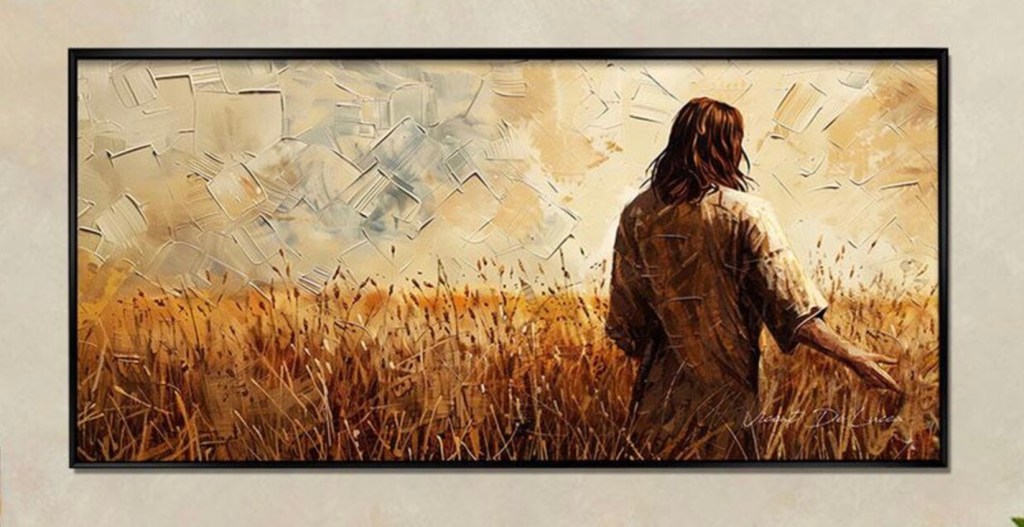
Painting: Accessed on Amazon.com wall art

Link for the Mass readings for Tuesday, April 28, 2026

Resist the thief and hired hand, trust only the Good Shepherd and follow his voice.

“I am the good shepherd, and I know mine and mine know me” (John 10:14).
Jesus, distinguished himself as the Good Shepherd who cared for his sheep instead of “thieves and robbers” who sought to harm the sheep. Nor is Jesus simply a “hired man” who has no personal investment in the flock and will abandon the flock at the mere sighting of a wolf. In referencing, “thieves and robbers and hired men” Jesus continued his calling out those Pharisees from chapter nine. Those who did not listen to his voice and those who were not leading God’s sheep with care.
The imagery of the shepherds is an echo back to past abuses such as in the time of Ezekiel who spoke out against those leaders who had “been pasturing themselves”, and who failed to “strengthen the weak nor heal the sick nor bind up the injured”. Thus the sheep of God’s flock, were scattered for lack of a shepherd, and became food for all the wild beasts. They were scattered and wandered over all the mountains and high hills; over the entire surface of the earth my sheep were scattered. No one looked after them or searched for them” (Ezekiel 34:2-10).
God, the eternal Shepherd, spoke through Ezekiel and said: “I will take my sheep out of their hand and put a stop to their shepherding my flock, so that these shepherds will no longer pasture them” (Ezekiel 34:10). Jesus is the fulfillment of Ezekiel’s prophecy. Jesus is the Son who God his Father sent to do just that. Jesus has come to gather the lost sheep and bring them to green pastures, and lead them with his voice to eternal life.
Even today, we have experienced so much abuse of power and corruption, self-seeking and self-aggrandizement, that we are weary and have lost faith in our leaders and institutions. Yet, all is not lost. Jesus is still among his flock and calling his sheep to himself. Let us not be deaf to the call of the Good Shepherd because of the “robbers and thieves” and “hired men” that have abused or abandoned the sheep.
Let us listen only for the voice of the Good Shepherd. We learn to know and identify his voice when we make the time to be still and listen. When we resist the temptation to run away or react out of fear. When we resist impulsive responses or seek immediate gratification, and are instead patient and trust in the voice of the Good Shepherd who has our best interest and intentions in mind and will care for us. Jesus will not harm us, because he loves us.
We may have been wounded or hurt when we have gone astray or even when we thought we were safe in the sheep pen. We can trust Jesus when he seeks to come close. Unlike the hired hand who will bolt at the first sign of trouble, Jesus is willing to stand with us and give his life for us. When wounded, his healing may initially provide an increase in pain and suffering for a time, as healing often does before we get better, but as we remain close to him, his healing balm will prevail. We will experience forgiveness, healing, renewal, and wholeness.
Jesus loves us, knows us, and calls each one of us by name. Mary Magdalene, in her grief, didn’t recognize Jesus when she met him after his resurrection, but when he called her by name she recognized his voice. May we, like Mary, remain still long enough, no matter the cause of our suffering, so that we can allow the Good Shepherd to come close and listen for his voice amidst the cacophony of so many other voices, robbers, and hired hands. Being patient and only moving with the Good Shepherd when he calls our name. Each time we follow his lead, we will grow in greater intimacy and unity with him.

Photo: Allowing ourselves to be quiet and still helps us to distinguish between the voices that seek to distract, divert, and tempt us away from the voice of Jesus who seeks to lead us to experience his love and peace.
Link for the Mass readings for Monday, April 27, 2026

May we allow ourselves to rest and be cared for by Jesus our shepherd.

I am not sure how many people reading this reflection are shepherds, live on a farm, or raise sheep. Many of us are most likely removed from the daily life and commitment of a shepherd. With such ignorance as our starting point, we can fall prey to a false romanticism of the life of a shepherd as a reaction to the fast pace and hustle and bustle of modern urban and suburban life. The commitment and demands of shepherds during Jesus’ time were demanding and all-consuming, with little acknowledgment or recognition. In fact, many shepherds were looked down upon, and groveling at the bottom of the social class of ancient Palestine. Yet Jesus compared himself to being a shepherd.
Just scratching the surface of the social context of shepherds could help to shed light on John’s Gospel today where Jesus paints an image of himself as a shepherd who when he calls his sheep they hear and recognize his voice so they follow him. the sheep hear his voice, “the shepherd calls his own sheep by name” (Jn 10:3).
Jesus is not just a shepherd, but the good shepherd. Good shepherds lived among their sheep, watched over them, cared for them, helped to birth and raise them, as well as was willing to protect them with his life from predators and thieves. Though we may not be fond of being compared to sheep, Jesus does the same for us. He watches, cares for, protects, nourishes us with his own Body and Blood, and has given his life for us. Jesus calls us by name. Imagine that. Really, ponder all the billions of human beings that have, exist now, and will ever exist, and Jesus knows each one of us by name. Are we willing to listen and come to him.
We can get in trouble when we stray from his protective care and wander away. Yet, just as a sheep baas and bleats, so the Good Shepherd is always close to hear when we call. Each one of us is precious and important to him. We just need to remember that truth and reach out to him daily and more importantly stay close to him. Yet, no matter how far we may find ourselves astray, he will come to us and will carry us back home on his shoulders.
I invite you to spend some quiet time with Jesus, the Good Shepherd, today. With the humility and simplicity of a lamb, allow yourself to rest your head on his lap, surrender to him all your cares, doubts, anxieties, and fears. Allow your self to feel the comforting weight of his hand and so be healed by confessing any sins that are weighing you down. Let him impart some healing balm on past hurts left unforgiven, and let him bind up any recent wounds. At some point in your contemplation, also let soak in the ultimate gift this shepherd gave: his life for each one of us that we might have life in him. A life not merely to exist or survive, but a life of joy, fulfillment, and wholeness.
————————————————-
Photo: Some quiet time resting with my Lord and my Shepherd.
Link for the Mass readings for Sunday, April 26, 2026

Having beheld and received Jesus, may we go forth to serve him in one another.

Jesus appeared to the Eleven and said to them: “Go into the whole world and proclaim the Gospel to every creature” (Mk 16:15). Jesus is once again claiming who he is: Kyrios – Lord. The word, gospel, comes from the Greek word, euangelion, meaning good news, but the one who proclaimed “good news” during the time of Jesus was the emperor. Caesar would send his emissaries to announce such good news as a great victory or his birthday. What Mark conveys in the very first line and here at the ending of his Gospel, is that Jesus is Lord! Not Kaiser Kyrios, Caesar is Lord, but Jesus Kyrios, Jesus is Lord!!!

We receive Jesus our Lord in an intimate way in the Eucharist. We receive his Body and Blood. We are loved and transformed by him each time we receive him by consuming him as we have been reviewing these past few days with Jesus’ Bread of Life discourse. When we are dismissed from Mass, one of the dismissal lines is, “Go and announce the Gospel of the Lord.” This is to echo the command of Jesus for all of us to proclaim the Gospel in our everyday experiences and encounters.

We proclaim the Gospel first and foremost by believing that Jesus is the Christ, the Son of God, our Savior and Lord. He has risen! He has risen indeed! He is the firstborn of the new creation. This is something to get excited about, something to fill us with joy. We are not to be a Grumpy Gus People, but an Alleluia People!!! Once we remind ourselves what we believe, who we believe in, who we are, and whose we belong to, then we are better prepared to engage with others.

The most powerful witness we can offer is when we seek opportunities to act, speak about and engage others with respect, caring, and joy. When we catch the eye of another offer a smile. We can also say hello, a nod of our head, or offer a wave, fist bump, high five, or a hug. We also need to be aware of other’s boundaries and respect their space at the same time. If someone is not open, we need to respect their posture, and meet them where they are.

Reaching out to others to acknowledge their dignity and value is the simplest, yet most profound way to spread the Gospel, which really means to share the love of Jesus by willing their good. We are to accept and accompany others as Jesus does with the purpose of building relationships. We are more inviting when we are willing to be patient, gracious, and willing to listen and hear in our interactions with each person we meet and in doing so we may begin to understand each other a little better.

Remember God gave us two ears and one mouth for a reason because it is better to listen first and speak second. As we encounter others, we are to also remember the common courtesy of saying please, thank you, and I forgive you, whether in a store, restaurant, bank, convenience store, on the sidewalk, in traffic, or online. It is just as important to engage in a similar fashion with those of our family, friends, and those closest to us.

Especially now, with our country and the world on edge and more anxious than ever, believing in Jesus, embracing his love, and putting into practice small actions with great love we can make a difference. As Pope Leo said in his homily on Holy Thursday: “Christ offers us the example of self-giving, service and love. We need his example to learn how to love, not because we are incapable of it, but precisely to teach ourselves and one another what true love is. Learning to act like Jesus — the living sign that God has placed within the history of the world — is the work of a lifetime.”


Photo: Pope Leo XIV celebrating Mass Holy Thursday Evening (@Vatican Media)

Link for the Mass readings for Saturday, April 25, 2026

“The source and summit of the Christian life.”

All that Jesus has been building up to is now coming to a climax. Any silent shock of disbelief or quiet murmuring has now escalated. The Jews quarreled among themselves, saying, “How can this man give us his Flesh to eat” (Jn 6:52)? Jesus hears the growing concern and disbelief. If he was speaking in a figurative or symbolic way, this would be the moment to clarify his point.
Jesus does speak, but he does not walk back or qualify his comments. Jesus doubles down: “Amen, amen, I say to you, unless you eat the Flesh of the Son of Man and drink his Blood, you do not have life within you” (Jn 6:53). Jesus does not only repeat that his disciples are to eat his Flesh but he also insists that they are to drink his Blood. Drinking or even eating meat with the blood of an animal was inconceivable for devout Jews. Also, the Greek used here in John’s Gospel for eat is trogein, which is used to describe how an animal eats, by gnawing and tearing at the flesh. The imagery that Jesus is using here is more graphic than the customary use of phagein, which would be used for chewing, as a human would chew their food.
Jesus continues to make his point that whoever does eat his Flesh and drink his Blood, will not only remain in him, but also Jesus will remain in them, and they will have eternal life. A wonderful end goal, but would any be able to make the leap of faith to get there? In tomorrow’s Gospel reading we will be able to see the response to Jesus’ claims.
Almost two thousand years later, we continue to have the opportunity to celebrate daily the person of Jesus in our midst. This happens through participating in “the source and summit of the Christian life” (Catechism of the Catholic Church, 1324), the Mass. Our hearts have the opportunity to be set on fire, as Cleopas and his companion, as we hear the word proclaimed during the Liturgy of the Word, and then Jesus is made known to us in the breaking of the bread in the Liturgy of the Eucharist. We are invited to experience an intimate encounter with the Son of God, as we consume him, Body, Soul, and Divinity.
That we eat the Flesh and Blood of Jesus may sound just as bizarre as it did to Jesus’ followers. The term we have for this miraculous transformation of bread and wine is transubstantiation. What happens at the calling down of the Holy Spirit and the words of institution which are invoked by the priest is that the substance, the reality, of the bread and wine is transfigured into the Body and Blood of Jesus, while the accidental form, or appearance, remains the same. So we consume Jesus’ unbloody, acceptable sacrifice. We consume his glorified body that has transcended the three dimensional realm as we know it.
Jesus is giving all of who he is corporally, holding nothing back of himself so that we receive all of him – Body and Blood, Soul and Divinity. The miracle does not stop there because in the receiving of Jesus’ fullness in the appearance of bread and wine, we also become divinized through our participation in his life as he permeates our whole being. We receive eternal life! This takes the saying, we are what we eat, to a whole new level.
This gift we get to then share. We are dismissed at the end of the Mass to go, like Mary, to bear Jesus Christ, to love others as Jesus loved us. In seeing and receiving Jesus in the Eucharist, we better see him in each other and are then inspired to serve one another. For what we do to the least of our brothers and sisters, we do to Jesus (cf. Mt 25:40). Jesus is risen, he has risen indeed. We are not alone. Jesus remains with us now and for all ages, most intimately in the Eucharist! We are alive and given eternal life, because the Bread of Life lives within and among us! Amen. Alleluia!
——————————————————–
Painting: “Christ with the Host”, by Paolo de San Leocadio
Link for the Mass readings for Friday, April 24, 2026