Subscribe to continue reading
Subscribe to get access to the rest of this post and other subscriber-only content.
“This is my commandment: love one another as I love you” (Jn 15:12).
God created us from the abundance and outpouring of his trinitarian love to be loved, and to love him in return. The love that Jesus is talking about is unconditional and not just relegated to those closest to us, although, hopefully, in our families and friendships is where we first experienced being loved and learned to love in return.
The love that Jesus commands that we are to participate in as his followers, is a going out from, a giving of ourselves to, and a willingness to sacrifice for one another. We are not to seek in return, but are to empty and give ourselves away. The return we get is from experiencing the infinite wellspring and source of the Holy Spirit that rises up within us. The more we hold back, the less we receive, the more we give, the more we experience. We are to resist withdrawing our love and assuming a selfish posture that leads to us becoming more like a stagnant pool. Instead, we are to remain open so as to allow the living stream of God’s infinite love to flow through us.
The love Jesus commands cannot be done on the fly. Love is accepting the interruption and choosing to be present. Love means stopping, setting aside our agendas, and accompanying another. Love is also not coercion and manipulation, it is accepting another as they are and where they are. Love is sharing the journey of life together. St Thomas Aquinas has written it best: Love is to will the good of the other as other. This is more than mere emotion, feeling, or sentiment but actually wanting the best for someone else and rejoicing in their becoming fully alive. Nor does this mean that we become doormats or enablers of dysfunctional or abusive behavior. We hold people accountable – for to love is also to be clear about respecting our’s and another’s dignity.
This practice of love is also not exclusive but universal. Yes, we are to love those in our family, community, place of worship, tribe, political party, and nation, while at the same time we must be willing to go out from our comfort zones and protected bubbles to risk opening ourselves up to those who we feel are different, those who do not see the world as we see it, and even those we consider our enemies. This does not mean we have to agree or even like someone else. Jesus commands us to love, to respect the dignity of the person as our starting point. This is the love he offers us and calls us to do the same.
Speaking and listening with a heart and mind open to the love of God is also a good way to participate in the divine communion of love that is shared between the Father, and the Son, and the Holy Spirit. Authentic communication happens when we state clearly our beliefs, our thoughts, and dreams, and also allow others to do the same. Even though we may differ in our points of view, we can still grow together in love. What may prevent us from doing so is our own wounds. These wounds can lead to reacting and talking at and over one another, demeaning, belittling, disdaining, and/or are condescending one another.
Receiving Jesus’ love regularly can help our healing process begin, and it will increase the more we share his love with others. Pope Leo has invited us to be “a Church that builds bridges and encourages dialogue, a Church ever open to welcoming”. We are welcoming and build such bridges of dialogue when we are willing to identify our own wounds, allow Jesus to love us there, and lead us to love as we have been loved. From that starting point we are better able to encounter the person and free ourselves from prejudicial caricatures and labels that hopefully will dissolve through our interaction and respectfully engaging with one another.
Instead of keeping each other at arm’s length, when we are willing to love as Jesus loves us, we will better be able to listen with patience and understanding. We will learn to embrace and grow from one another. Yet, there will be those that are not willing to respect us nor dialogue. We can still love them and respect their position. We can hope for an opening and seek for a movement of mutual, loving dialogue. Even if not, we at least can resist adding fuel to the fire. Let our starting point be to recognize and remember who we are, beloved daughters and sons of God our Father, seek to approach each other in love and in our engagement, and let God happen.
—————————————————————-
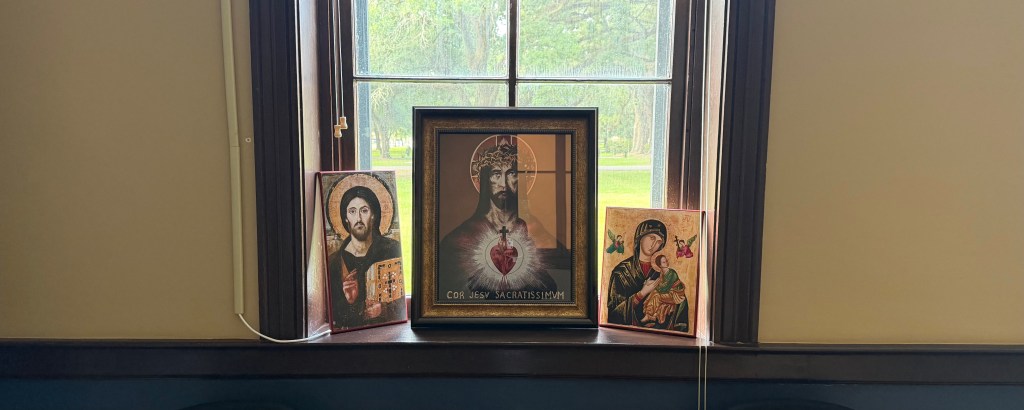
Photo: Quiet time to be with Jesus before our communal Mass here at our annual priest convocation.
Pope Leo XIV quote from his May 8 Ubi et Orbi message
As the branch of the vine matures, it begins to look more like the vine itself. As the branch remains connected to the vine, as it is sustained by the nourishment provided, and protected by the vine grower, the branches become more and more conformed to the vine. This is also true in the event that a branch not originally attached to the vine is grafted to it. Over time, the branches are almost indistinguishable from the vine itself. The blessing of the vine does not stop there. A healthy and mature branch will also bear fruit.
Our hope, as disciples of Jesus, no matter what our background, culture, gender, ethnicity, or race will be the same. We are to be one as the Son and the Father are one. As St Paul has written to the Churches in Galatia and Collosse: “In Christ there is neither Jew or Greek, circumcision or uncircumcision, male or female, barbarian, Scythian, slave or free because we are all one in Christ” (cf. Galatians 3:28, Colossians 3:11).
Being a disciple of Jesus is not being a mindless follower of his. Quite the opposite! The more we are conformed to Jesus, the more we come to know him and also come to experience the unique gift of ourselves. We begin to let go of the pressures to conform to the pressures of the world, that which stunts our growth, and begin to embrace the freedom and truth of who we are. That freedom that just wants to burst out is allowed to be free when we die to our false selves and live in the love of Christ.
We will experience the freedom of being fully alive when we accept the invitation of Jesus to enter the divine communion of love between himself and his Father. We remain connected to him as the vine when we also “obey Jesus and love one another with God’s radical, self-giving love” (Martin and Wright, 254). Focusing solely and turning in upon ourselves disconnects us from the vine, from the very source of our lives. Just as the body will suffer without water and food, so our soul will suffer if we are separated from the living spring of our sustenance. Remaining attached to Jesus, the vine, means that we will mature and bear the fruit of joy that expands out beyond ourselves to engage others.
A good measure of our ripe harvest is when we: “Put on then, as God’s chosen ones, holy and beloved, heartfelt compassion, kindness, humility, gentleness, and patience, bearing with one another and forgiving one another, if one has a grievance against another; as the Lord has forgiven you, so must you also do. And over all these put on love, that is, the bond of perfection. And let the peace of Christ control your hearts, the peace into which you were also called in one body. And be thankful” (Colossians 3:12-15).
————————————————————-
Photo: Accessed from Coravin Wine
Martin, Francis and Wright, IV, William M. The Gospel of John. Grand Rapids, MI: Baker Academic, 2015.
“Whoever has my commandments and observes them is the one who loves me” (John 14:21).
Especially in our modern, western mind set, the idea or mere mention of following commandments may cause a bristling. Mostly this is because of the witnessing weakness of our fallen nature expressed in egregious ways through the abuse of power, abuse in relationships, and a weakening of trust in secular and religious institutions.
Jesus though is offering more of a challenge as he draws the following of commandments and love together. He is sharing with his apostles in the beginning stages of his farewell discourse, and before his crucifixion, what he feels is most important to share. His testament that he not only wants to give, but these final words he wants to impart upon them in such a way that they continue to learn and receive his teachings, put them into practice, allow themselves to be transformed by and so perpetuate them.
Just as commandments can lead one to bristle, love has many more superficial meanings than what Jesus means. One reason is that, even though the English language has a plethora of words to utilize and choose from, there is only one word for love and it is interpreted and used in many ways. In Ancient Greek, there are four words that are used to connote love. There is eros, which has to do with attraction. It is the beginning stage of love because we are drawn out of ourselves as we are attracted to another. The next word for love is philia, which aligns with friendship, a wanting to be together, to share between friends. If our love matures it moves from attraction or infatuation to friendship. The third word, storge, is the deeper love shared with family members which can be through blood or a deepening of friendship. The fourth word is agape, which is unconditional love, a sacrificial love.
When Jesus shares that we are to follow the commandments, he is not demanding that we do so as a tyrant would. He is providing boundaries, guard rail, parameters for us to grow and mature as people who love, who, in the words of St Thomas Aquinas, will the good of the other as other. As humans, we are social beings. We want to belong, to be accepted, and to be a part of. We seek meaning, purpose, and fulfillment in our lives. This is best done through cooperation and collaboration with God and with one another, striving to love unconditionally, agape. We desire to belong, to be loved, and to love in return. Yet, we need to ground our love in God first or our pursuit of love and belonging will be disordered.
As a good son of St. Augustine, Pope Leo XIV quoted Augustine in his inaugural Mass as Pope last year: “Lord, you have made us for yourself, and our heart is restless until it rests in you (Confessions, I: 1,1).” We are made by God to be loved and to love in return. Nothing we seek in this world will satisfy this deepest hunger that we all have in our soul besides the love God has for us. Unfortunately, we succumb to many disordered affections in pursuit of the love we seek. We are led astray by apparent goods that leave us hungry, thirsty, and wanting for more.
If we operate from a self-centered posture in which we are only turned in upon our self, and we only seek to manipulate and get from others, or worse, objectify others. Instead of working for consensus and sharing a common vision, we will ultimately be empty with the exchange on any level, because even in our relationships as with material things, we will be left wanting more. This is true because once the immediacy of the stimulation, whether material, emotional, or sensual, ends, so does the experience of the feeling. Some happiness may linger from the effect, but we will never be filled or satisfied with that which is finite. We will continue to seek more and more until the pursuit of instant and constant gratification ensnares us and we are entangled in a web of addiction.
God’s commandments, grounded in love, are meant to provide boundaries for us, training wheels, and to keep us free from enslavement to sin. The commandments point us to that which is not apparently but truly good for a wholesome and whole life. At the same time God’s commandments and the teachings of Jesus help us to mature as persons moving away from a posture of being self-centered to becoming disciples that love as Jesus loves.
Discipline in this way is meant to be a means of freedom for excellence such that we can become who God calls us to be and who we truly desire to be. God is not in competition with us. He is our biggest fan. As St Irenaeus wrote, the glory of God is the human being fully alive! When we can rest in the truth that God loves us as we are, even in our sin, when we can stop, breathe, receive, rest, and abide in his love, we can begin to settle and feel safe. Our restlessness can slow, the grasping can release, and we can just be, be loved, be ourselves, and experience peace.
Commandments and morality imposed indiscriminately, without reason or an end goal is a bludgeon. Love and mercy without accountability and justice can be enabling. Jesus’ invites us to receive and observe his commandments so that we may be freed from disordered affections and so properly order and discipline our desires and passions to be free to love authentically. Jesus knows what will truly fulfill and give us deeper meaning. May we trust in and learn from the deposit of faith passed on from Jesus to the Apostles, to each successive generation, as well as the ongoing guidance of the Holy Spirit, our Advocate that the Father sent in his name (John 14:26).
Pope Leo XIV, the vicar of Christ, implored us about a year ago: “Brothers and sisters, this is the hour for love! The heart of the gospel is the love of God that makes us brothers and sisters.” We are brothers and sisters, disciples of Jesus, when we receive and put into practice Jesus’s commandments, when we love him and his Father, we are given the discernment to reveal the lies of the enemy, we grow, and mature in our spiritual lives. The “heart of the gospel” Pope Leo preached in his inaugural address echoed again in his Sunday Regina Caeli address, May 3, 2026.
Having faith in God and Jesus “frees our hearts from the anxiety of possessing and acquiring, and from the illusion that we must pursue a position of prestige to have worth. Each person already has infinite worth in the mystery of God, which is the true reality. By loving one another as Jesus has loved us, we impart this awareness to one another… through love, amidst a multitude of brothers and sisters, each one discovers that they are uniquely made.”
Let us allow and continue to allow the tender chords of the Holy Spirit’s love to draw us deeper into intimacy with Jesus so that we can be transformed, forgiven, and healed by his love, and so freed from the false lures and promises that seek to divert us from being the beloved daughters and sons of God our Father that he has uniquely created us to be.
Photo: Pope Leo Regina Caeli address (Vatican Media)
Quotes above from Pope Leo XIV Inauguration Mass, May 18, 2025: Transcript of Pope Leo XIV’s Homily
Philip said to him, “Master, show us the Father, and that will be enough for us.” Jesus said to him, “Have I been with you for so long a time and you still do not know me, Philip” (Jn 14:8-9)?
Again we see the Apostles struggling to understand that Jesus and the Father are one, that Jesus is the Son of God. Jesus attempts to explain again to Philip that whoever sees him sees the Father.
The challenge here is that Philip and Jesus are using the same language but talking from different points of view. When Philip is asking Jesus to show him the Father through physical eyes, he is asking to see God along the lines of what we might perceive from Michaelangelo’s Sistine Chapel painting of God. Jesus has been revealing the Father through the spiritual eyes of his works. Or: “He might be looking for a grand theophany, because his request of Jesus, Show us the Father, recalls Moses’ request of the Lord at Mount Sinai: ‘Let me see your glory!” (Exodus 33:18).” (Martin and Wright, 246).
God is not finite, he is not a being like we are. He is neither male nor female. We use the term Father because Jesus used it often to speak of him, and thus why we use the pronoun him. Jesus used analogous language to create a bridge of understanding for us who are finite, human beings to help us understand better that we can have a relationship with our God who is Infinite Act. God’s essence and his existence is one and the same. Even though God is beyond any genus of being, beyond any way for us to classify him, we can still know and experience God.
Jesus shared with Philip that “The Father who dwells in me is doing his works. Believe me that I am in the Father and the Father is in me, or else, believe because of the works themselves” (Jn 14:11).
When Jesus heals, exorcises demons, speaks on his own authority, associates with those on the peripheries, these are some of the ways he is revealing the Father. In these very acts, he is loving those in his midst, he is willing their good. When Philip and the Apostles believed in Jesus and acted in his name they revealed Jesus and so his Father to others. When we love one another as Jesus loves us, live and act from the love we have received from Jesus, we also will reveal Jesus and the Father to others!
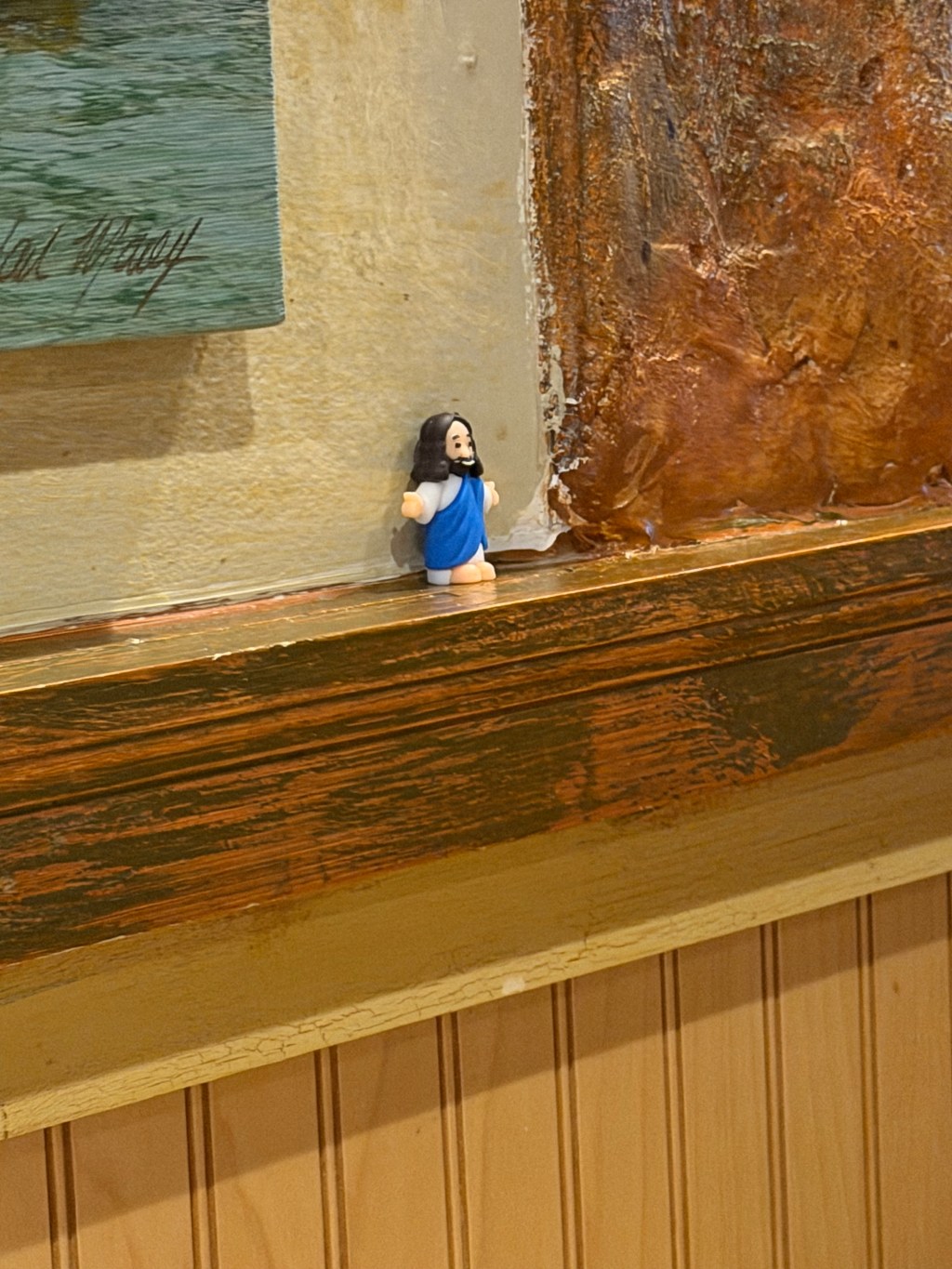
Photo: Jesus helps us to remember that we are each beloved daughters and sons of his Father, to be loved by him, to breathe, receive, rest and abide in his love for us and to love in return.
Martin, Francis and William M. Wright IV. The Gospel of John. Grand Rapids, MI: Baker Academic, 2015.
Link for the Mass readings for Sunday, May 3, 2026